TrendRadar: Turning the Internet's Hot Topics into a Trackable, Analyzable, Conversational AI Intelligence Pipeline
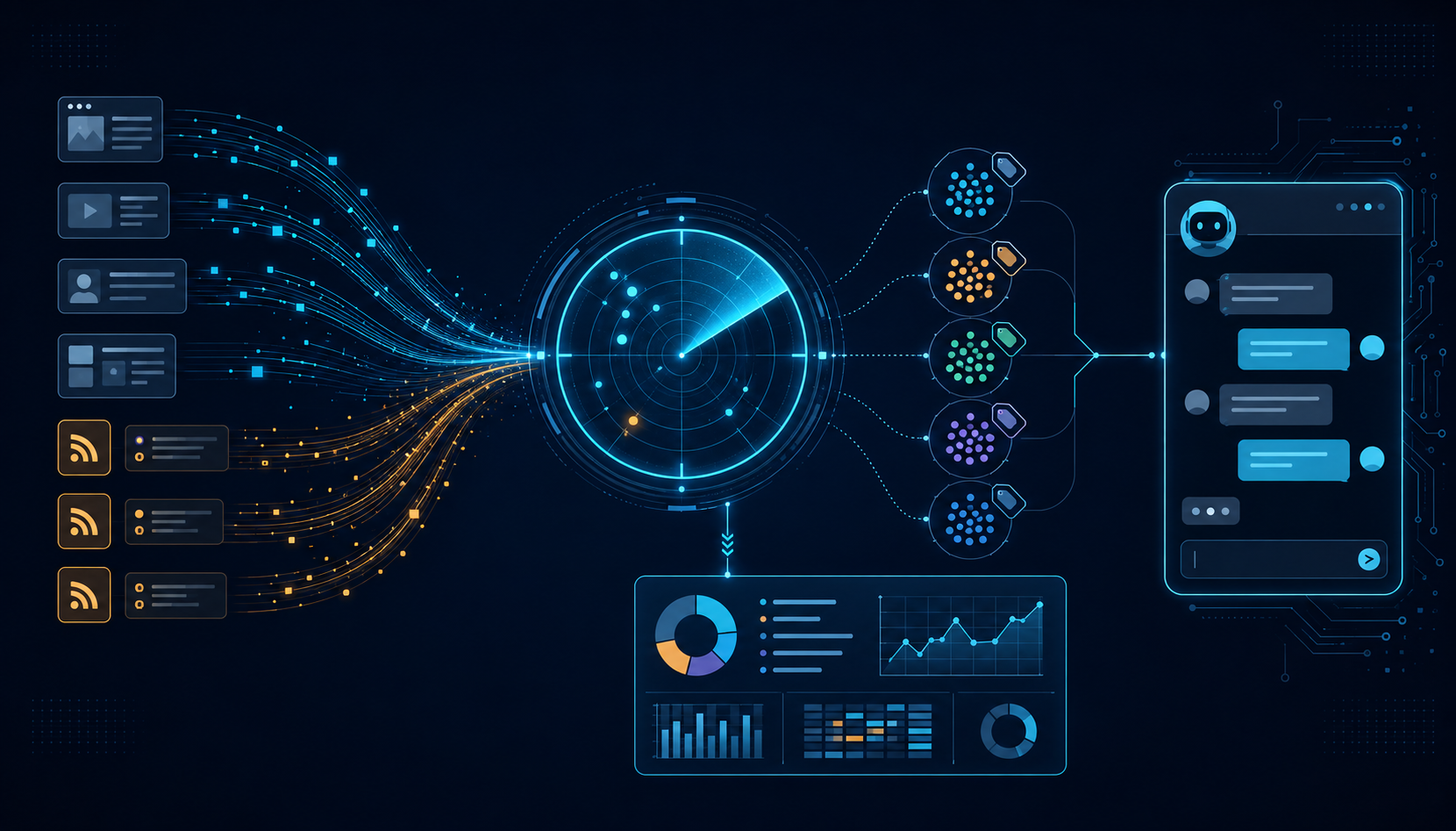
TrendRadar: Turning the Internet's Hot Topics into a Trackable, Analyzable, Conversational AI Intelligence PipelineThe daily information problem is rarely a lack of news. It is the lack of a stable way to keep the signals that actually matter. A trending list can show what is rising right now, but it does not automatically answer whether a topic has appeared for several days, whether discussions across platforms describe the same event, or which items in a user's watchlist deserve immediate attention instead of being temporary noise.[sansan0/TrendRadar](https://github.com/sansan0/TrendRadar) is interesting because it is not positioned as only a news crawler or notification script. It combines collection, filtering, storage, reporting, delivery, and AI analysis into a self-hostable intelligence pipeline. GitHub data checked on August 24, 2026 showed about 61,726 stars, 24,876 forks, and a latest push on July 17, 2026. The project is both highly adopted and actively implemented.This article does not present TrendRadar as a universal news-truth machine. Instead, it examines the engineering problem it actually addresses: turning unstable, fragmented, hard-to-revisit public signals into a scheduled, persistent, pushable data flow that can also be queried by AI.## The key idea: TrendRadar is a data flow, not just a trending listTrendRadar is easier to understand as five layers:1. **Sources:** collect hot-topic feeds from multiple platforms and RSS/Atom feeds.
2. Rules: express what matters through keyword groups, aliases, regular expressions, and item limits.
3. State: persist news and history with local SQLite or S3-compatible remote storage, supporting incremental delivery and historical tracking.
4. Outputs: generate HTML reports and send notifications through Telegram, WeChat Work, Feishu, Slack, email, ntfy, Bark, and other channels.
5. Understanding: use AI for translation, interest-based filtering, and trend analysis, or expose accumulated local data through MCP to compatible AI clients.This separation matters. Collection and model calls are not the same dependency. Without an AI API key, basic hot-topic collection, RSS monitoring, keyword matching, and HTML reporting can still work. AI becomes an understanding layer on top of an existing pipeline instead of the only entry point.## From hot topics to a report### Collect first, ask the model laterTrendRadar can process hot-topic platforms and RSS at the same time. Hot-topic feeds are useful for short-term momentum and rankings, while RSS is better for following stable sources. The project brings RSS into the same keyword grouping and display flow, so users do not need two unrelated reading interfaces.The design also creates a useful boundary: AI analysis does not have to perform live web search. The official documentation explains that the MCP analysis function primarily works on news already accumulated in the output directory. Traceability therefore depends on consistently storing source data, not on writing a more elaborate prompt for a one-off answer.### Describe interests in configurationBasic keyword configuration lives in config/frequency_words.txt. Groups, aliases, comments, item limits, and regular expressions can turn a watchlist into a version-controlled configuration. Users who do not want to encode every interest as a rigid word list can describe an interest in natural language in config/custom/ai/ai_interests.txt, such as wanting AI and clean-energy industry news. The AI can extract labels and score each candidate item.A practical engineering decision is the fallback path: when AI filtering fails, the system can fall back to keyword matching so a model error does not stop the notification pipeline. AI can improve recall and ranking, but service availability should not depend on one successful model call.### Separate new items from persistent popularityMonitoring tools create fatigue when the same story is repeated merely because it remains popular. TrendRadar provides incremental monitoring so users can focus on newly appearing matches while retaining modes for observing overall popularity. The same dataset can serve different workflows: new-item notifications for frequent monitoring, morning and evening briefs for trend review, and historical data for research.## Three levels of AI capability### TranslationRSS and hot-topic sources may use different languages. TrendRadar can translate selected regions and share model configuration with AI analysis. The value is not replacing the original article; it reduces the cost of deciding whether the original deserves a closer read.### Intelligent filteringTraditional keywords are precise but rigid. A watchlist containing only LLM may miss related stories that use different terminology, while a broad list creates noise. AI filtering lets users describe a direction in natural language and score candidate items. In production, keyword fallback should remain enabled, and the AI score should be treated as a ranking or filtering signal rather than a factual verdict.### AI analysisAI analysis can produce a trend overview, keyword-heat observations, cross-platform relationships, and potential-impact assessments. Delivery can include only raw items, only the analysis, or both. The analysis scope can also be independent from the delivery scope: send only new items to avoid repeated interruptions, while analyzing the complete day's dataset to preserve context.A summary is not evidence. Sentiment, impact estimates, and cross-platform relationships generated by a model should be checked against original titles, source URLs, and timestamps. TrendRadar provides an analysis entry point; it should not be used as a reason to remove editorial verification.## MCP turns stored news into a conversational workspaceAnother important feature is the separate MCP Server. Rather than embedding an arbitrary chat window into a crawler, TrendRadar separates the notification service from the AI analysis service. wantcat/trendradar handles scheduled collection, reports, and notifications; wantcat/trendradar-mcp exposes an MCP interface for querying and analyzing existing data.This boundary has three benefits:- Independent deployment: users who only need notifications do not need to run MCP; the MCP service can be added when conversational analysis is useful.
- A clearer data boundary: AI queries accumulated local data instead of being allowed to imply that it has seen the live web.
- Client flexibility: the documentation describes configuration for Cherry Studio, Claude Desktop, Cursor, Cline, Continue, and other MCP clients.In Docker deployments, the MCP HTTP endpoint is
http://localhost:3333/mcp. The documentation recommends keeping the service on localhost first. Remote access requires a reverse proxy and authentication. This is not merely an operational detail: news data can reveal research plans, company intelligence, or personal preferences. Authentication, network scope, and retention should be designed before exposing the endpoint publicly.## Three deployment paths and their trade-offs### DockerDocker is the recommended path for long-running installations. Compose can manage the notification service and optional MCP service, while volumes preserve configuration and data. This is a natural fit for a NAS, home server, or cloud host that needs incremental delivery, historical tracking, and local reports.Functional behavior belongs inconfig/config.yaml, keywords inconfig/frequency_words.txt, and secrets such as API keys and webhook URLs indocker/.env. Environment variables override YAML values, allowing deployment-specific changes without editing tracked configuration.### GitHub ActionsGitHub Actions avoids a permanently running server and works well for scheduled reports. The runner is ephemeral, however, so local files do not automatically survive between runs. Users who need incremental delivery and historical tracking must configure S3-compatible storage such as Cloudflare R2. The main cost is not compute; it is correctly managing secrets, storage, and schedules.### Local PythonThe project documents local execution withuv. This is the friendliest route for developers who want to study sources, change matching logic, or add a custom notifier, but it also means taking responsibility for the Python environment, scheduling, process supervision, and backups.## A practical configuration strategyFor a technical-intelligence workflow, a sensible sequence is:1. Start with one source and one notification channel. Confirm that an HTML report is generated and the first notification arrives.
2. Organize a small number of keyword groups, such as models, developer tools, and infrastructure. Do not begin with the entire domain vocabulary.
3. Establish a keyword baseline for a day or two, then add AI filtering after observing false positives and missed items.
4. Separate delivery and analysis windows: send new items during frequent windows, and generate a complete analytical brief in the morning or evening.
5. Enable MCP only when conversational review is needed, and validate it on 127.0.0.1 before considering remote access.
6. Set a retention policy. A longer history increases analytical value, but also increases the risk of retaining sensitive information.The principle is to verify the data flow before adding models and integrations. If the source, scheduler, or storage is unstable, adding a more expensive model only makes the root cause harder to isolate.## Who should use it?TrendRadar fits people who need to follow topics over time without opening a dozen sites every day. Open-source maintainers can monitor dependencies and competitors, researchers can put RSS and hot-topic feeds on one timeline, and teams can deliver selected briefs to existing communication channels. It is also a useful project for developers exploring MCP as a data-workspace interface rather than merely a tool-calling protocol.It is not a substitute for complete news coverage, trading-grade latency, or formal editorial verification. Source APIs, page structures, and availability can change, and AI summaries can misread context. Production workflows still need source allowlists, error monitoring, human sampling, and access control.## Final assessment: make attention management operableThe most useful lesson in TrendRadar is not the number of notification integrations. It is the conversion of information anxiety into engineering questions: where does data come from, how is it grouped and deduplicated, what should be delivered versus analyzed, where is history stored, and what can the AI actually access?Once those boundaries are encoded in configuration, storage, and service architecture, AI stops being a daily paragraph generator and becomes a traceable, reviewable, adjustable intelligence pipeline. For anyone building a personal or team AI workspace, that is closer to a durable product shape than simply adding another chat entry point.## Sources- GitHub repository: sansan0/TrendRadar
- Official quick-start documentation: Choose a deployment method
- Official AI-analysis documentation: AI analysis
- Stars, forks, and latest-push data: GitHub Repository API, checked on August 24, 2026